



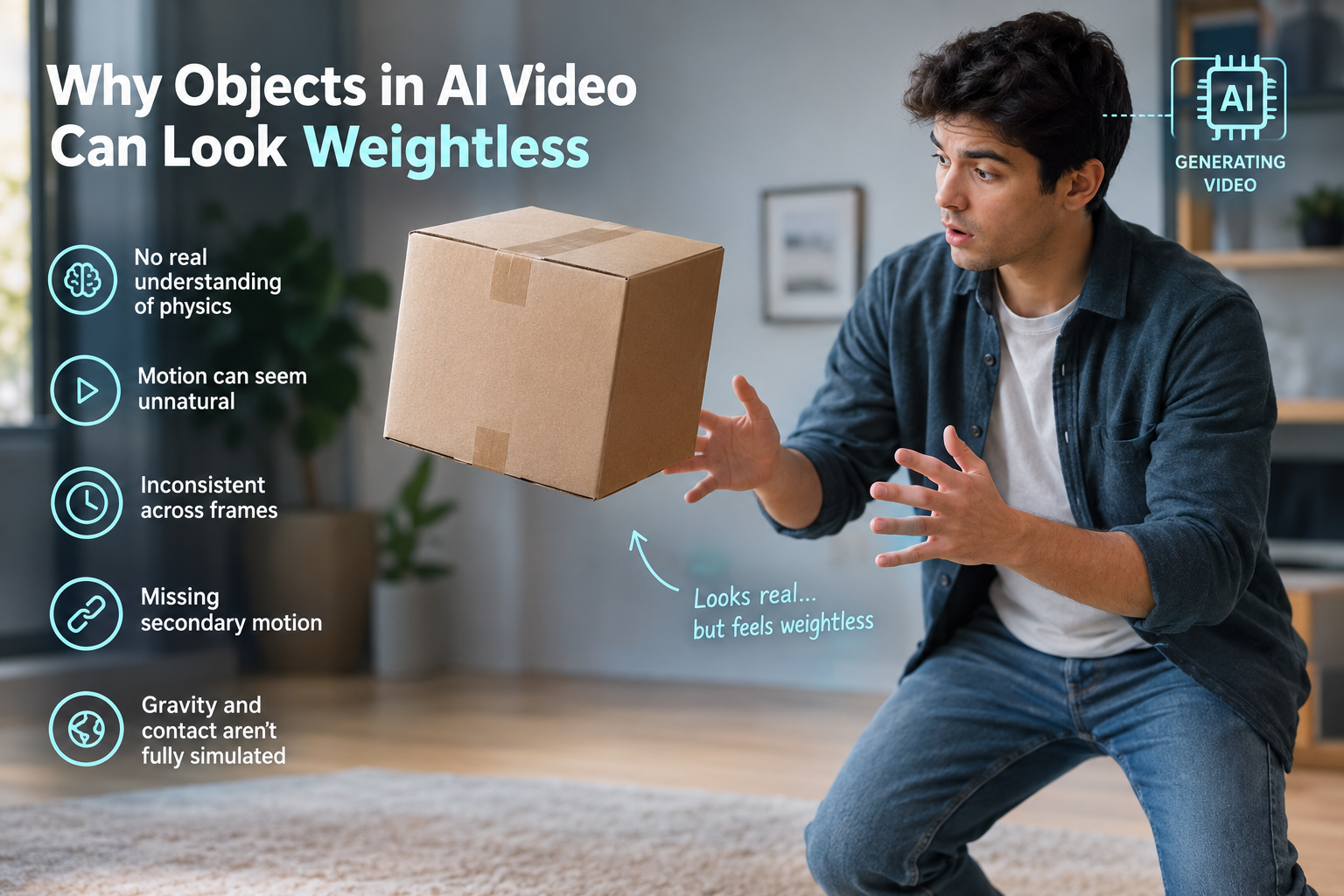
AI-generated video has become remarkably convincing, but anyone who watches closely can still notice moments that feel slightly “off.” One of the most common examples is when an object appears to move without proper weight. A ball may bounce as if it is made of paper, a person may pick up a heavy box with almost no effort, or a vehicle may stop without showing the physical response we would normally expect.
This strange effect is not necessarily caused by poor image quality. In many cases, the video can look visually impressive while still failing to reproduce the physical rules that make objects feel solid and believable. The reason is that AI video models are primarily designed to generate convincing visual patterns rather than perfectly simulate the laws of physics.
Understanding why objects in AI video can look weightless reveals a lot about how generative video works. It also explains why certain clips look realistic for a few seconds before suddenly becoming unnatural. Let’s explore the main reasons behind this effect and what AI developers are doing to improve it.
AI Video Does Not Understand Physics Like Humans Do
One of the biggest reasons objects can look weightless in AI-generated video is that the model does not understand physics in the same way a human does. When people watch an object fall, they automatically understand concepts such as gravity, momentum, mass, friction, balance, and resistance. We do not need to calculate these forces consciously because our brains have learned them through years of interacting with the physical world.
AI video models approach the problem differently. They learn statistical relationships from enormous collections of images and videos. During generation, the system predicts what visual information should appear next based on the prompt, the previous frames, and patterns learned during training. It can become extremely good at producing the appearance of movement without necessarily calculating the physical forces responsible for that movement.
This distinction is important. A model may know what a person carrying a box usually looks like because it has seen thousands of similar scenes. However, it may not have a complete internal simulation of the box’s mass, the person’s muscle effort, the friction between their shoes and the floor, and the shifting center of gravity. The resulting video can therefore look visually correct while feeling physically wrong.
That is why AI-generated motion sometimes has a dreamlike quality. The object is moving, but the movement does not always communicate mass. The model is essentially creating a plausible sequence of images rather than running a traditional physics engine underneath the scene.
Weight Is Communicated Through Movement
An object’s weight is not visible in a single still frame. Instead, viewers infer weight from how the object behaves over time. This makes motion extremely important when judging whether something looks heavy, light, solid, or even physically possible.
For example, imagine two identical boxes. In one video, a person bends their knees, grips the box firmly, struggles slightly, and slowly lifts it. In another, the person grabs the same box and raises it effortlessly with one hand. The box itself may look exactly the same in both clips, but the first scene makes it feel heavy because the movement communicates resistance.
AI video can struggle with these subtle signals. A generated character may move an object smoothly from one position to another without showing the tiny changes in posture and muscle tension that humans expect. The result can make the object seem unusually light.
The same problem occurs with falling objects. A heavy object usually accelerates downward, lands with force, compresses or reacts to the surface, and may cause secondary movement. If an AI model creates only a visually approximate version of these events, the object can appear to float, drift, or bounce unnaturally. Viewers immediately notice the difference because physical weight is something humans are exceptionally sensitive to.
Motion Consistency Can Break Across Frames
Another major problem is temporal consistency. AI video is made up of a sequence of frames, and the model must maintain the appearance and position of objects as the scene progresses. This is much harder than generating one convincing image.
An object might have the correct shape and position in one frame but gradually change its movement in later frames. Its trajectory can become slightly inconsistent, or its relationship with nearby objects can shift. Even tiny errors can make the object appear disconnected from the physical environment.
Suppose an AI-generated video shows a metal ball rolling across a table. In a physically realistic scene, the ball should follow a continuous path and gradually respond to friction. If the generated ball suddenly changes speed or appears to glide without resistance, the viewer may interpret it as weightless.
The problem becomes even more obvious when several objects interact. A person may place a cup on a table, but the cup might appear to float a fraction above the surface. A chair may move without producing the expected contact with the floor. These small inconsistencies undermine the viewer’s sense that all objects exist in the same physical world.
AI Often Misses Secondary Motion
Real-world movement rarely happens in isolation. When something heavy moves, other things around it usually react. These reactions are called secondary motion, and they play a major role in making video feel realistic.
Consider someone dropping a large suitcase onto a floor. The suitcase moves downward, but that is not the only event. The person’s arm changes position, their body may shift backward, the suitcase may compress slightly, the floor may respond to the impact, and nearby objects may vibrate. All these details help communicate force and weight.
AI-generated video may capture the primary action while missing some of these secondary effects. A person might throw an object, but the object may travel without causing a believable reaction when it lands. Alternatively, the character’s body might remain strangely stable despite performing a forceful action.
This missing secondary motion can make an object look weightless even when its basic movement is technically correct. Human viewers are accustomed to seeing chains of cause and effect. When those chains are incomplete, our brains quickly detect that something is not behaving naturally.
Gravity Is More Complicated Than It Looks
Gravity seems simple because we experience it constantly, but realistically depicting gravity requires maintaining several relationships at once. Objects should accelerate downward, characters should maintain balance, surfaces should provide support, and objects should respond appropriately when they collide.
AI video models can reproduce a falling object, but reproducing the exact sequence of physical consequences is more difficult. An object may begin falling correctly and then slow down for no apparent reason. It may hit the ground but fail to produce a convincing impact. It might also bounce too high or stop too quickly.
These errors are especially noticeable in scenes involving jumping. When a person jumps, their body follows a predictable arc. Their feet leave the ground, their body rises, reaches a peak, and then returns under the influence of gravity. The landing also requires the knees, hips, and body position to respond to the impact.
If those stages are inconsistent, the person can appear to float. The same applies to animals, vehicles, sports equipment, and almost anything else moving through three-dimensional space.
Contact With Surfaces Is a Major Challenge
Objects feel heavy partly because they interact with surfaces. A chair rests on the floor. A glass sits on a table. Shoes press against the ground. A car’s tires grip the road. These contacts provide constant visual evidence that objects occupy physical space.
AI-generated videos sometimes struggle to maintain these contact points. An object may appear to slightly penetrate a surface, hover above it, or slide without friction. Even when the error is tiny, it can dramatically affect perceived realism.
Human vision is extremely sensitive to contact relationships. We instinctively expect shadows, reflections, pressure, and positioning to agree with physical contact. If a heavy object is supposedly resting on a table but its shadow suggests that it is floating, the scene immediately feels artificial.
This is one reason simple objects can expose AI-generated video errors. A complicated background may distract the viewer, but a cup sitting on a table creates a straightforward physical relationship. If that relationship is wrong, there is little else to hide the mistake.
Momentum and Inertia Can Be Difficult to Reproduce
Weight is closely connected to momentum and inertia. Heavy objects generally require more force to accelerate, stop, or change direction. Even when two objects move at the same speed, their movements can communicate very different levels of mass.
Imagine a truck suddenly turning around a corner. Its body would naturally lean, its suspension would respond, and its tires would interact with the road. A small bicycle would behave differently. The physical differences are part of what makes the truck feel massive.
AI video generation can sometimes treat different objects as if they follow similar movement patterns. The visual model may recognize that both a truck and a small object are moving, but it may not reproduce the distinct physical behavior associated with their different masses.
This can produce a peculiar effect where large objects move with the agility of lightweight props. A huge machine might turn too quickly, or a massive door might swing open without showing resistance. The scene can be visually detailed yet still fail the basic test of physical plausibility.
Character Movement Also Affects Perceived Weight
Objects do not have to move by themselves to look weightless. Sometimes the problem comes from the human or animated character interacting with them.
When people lift, push, pull, or carry something heavy, their bodies respond to the force. Their shoulders move, their posture changes, their feet adjust, and their muscles create visible tension. These details are essential for selling the object’s weight.
AI-generated characters can sometimes perform actions with unnaturally smooth body movements. A person may lift a large object while keeping their upper body almost perfectly stable. They may also walk at a normal pace while carrying something that should obviously affect their balance.
Because viewers understand human movement so well, these mistakes are easy to notice. We may not consciously identify the exact problem, but the scene simply feels wrong. The object appears lighter than it should because the character is not responding to its mass.
Why AI-Generated Physics Can Improve Over Time
The good news is that AI video technology is developing rapidly. Researchers and developers are increasingly interested in improving physical consistency rather than focusing only on visual quality.
One promising direction is combining generative models with stronger representations of three-dimensional space. Instead of treating a scene primarily as a sequence of images, future systems may develop more detailed internal models of objects, surfaces, depth, and motion.
Another possibility is the integration of physics-based simulation. Traditional physics engines are very good at calculating how objects should move under specific forces. Generative AI is very good at producing realistic visual appearances. Combining these strengths could produce video that looks natural while also obeying physical rules.
Training data is also likely to become more sophisticated. As models receive more examples of real-world interactions, they may become better at recognizing the relationship between actions and physical consequences. Instead of merely learning that a person can pick up a box, the model could become better at understanding what lifting different types of boxes actually looks like.
How Viewers Can Spot Weightless Objects in AI Video
There are several clues that can help identify when an object does not have convincing weight. One of the easiest is to watch how quickly it starts and stops moving. Sudden changes without visible force often indicate that the motion is not physically consistent.
Pay attention to contact points as well. Does the object actually appear to touch the floor or table? Does it slide without resistance? Does it bounce in a believable way after impact? These details can reveal problems that are less obvious when watching the entire scene casually.
Finally, observe the people interacting with the object. If someone carries an enormous item with the same body language they would use for an empty cardboard box, the object may appear weightless. The human reaction is often a better indicator of physical realism than the object itself.
The Difference Between Visual Realism and Physical Realism
One of the most interesting things about AI video is that visual realism and physical realism are not the same. A clip can have beautiful lighting, detailed textures, realistic faces, and impressive camera movement while still failing to convince us that the objects have real mass.
Visual realism asks whether something looks believable. Physical realism asks whether it behaves according to the rules we expect from the real world. The second challenge is considerably harder because it requires consistency across time, space, objects, and interactions.
This distinction explains why some AI-generated videos can fool us at first glance but become strange when watched carefully. The surface details are convincing, but the underlying behavior is not always coherent.
As AI video models become more capable, this gap is likely to shrink. The future of realistic video generation will not depend only on sharper images or better-looking characters. It will also depend on making objects move, collide, accelerate, stop, and interact in ways that feel physically inevitable.
Conclusion
Objects in AI video can look weightless because generating convincing images is not the same as accurately simulating physics. AI models can learn the visual appearance of movement from huge amounts of data, but they may not always reproduce the forces, momentum, friction, gravity, balance, and secondary motion that give objects their sense of mass.
Small inconsistencies can make a major difference. A character who does not react to a heavy object, a box that stops too quickly, a ball that floats slightly above a surface, or a vehicle that changes direction without realistic momentum can all break the illusion.
As generative video technology continues to evolve, better physical reasoning will become just as important as better visual quality. The most convincing AI videos will not simply look real. They will behave real. And when objects respond naturally to gravity, surfaces, forces, and each other, viewers will have a much harder time distinguishing generated footage from reality.
You May Also Read: Richard Wolcott Carson: The Life and Story of Johnny Carson’s Son
for more visit newspeaka.co.uk

1 Comment
Pingback: John Nesta Marley: Life, Family, Career, and the Legacy Behind His Name - NewsPeaka