



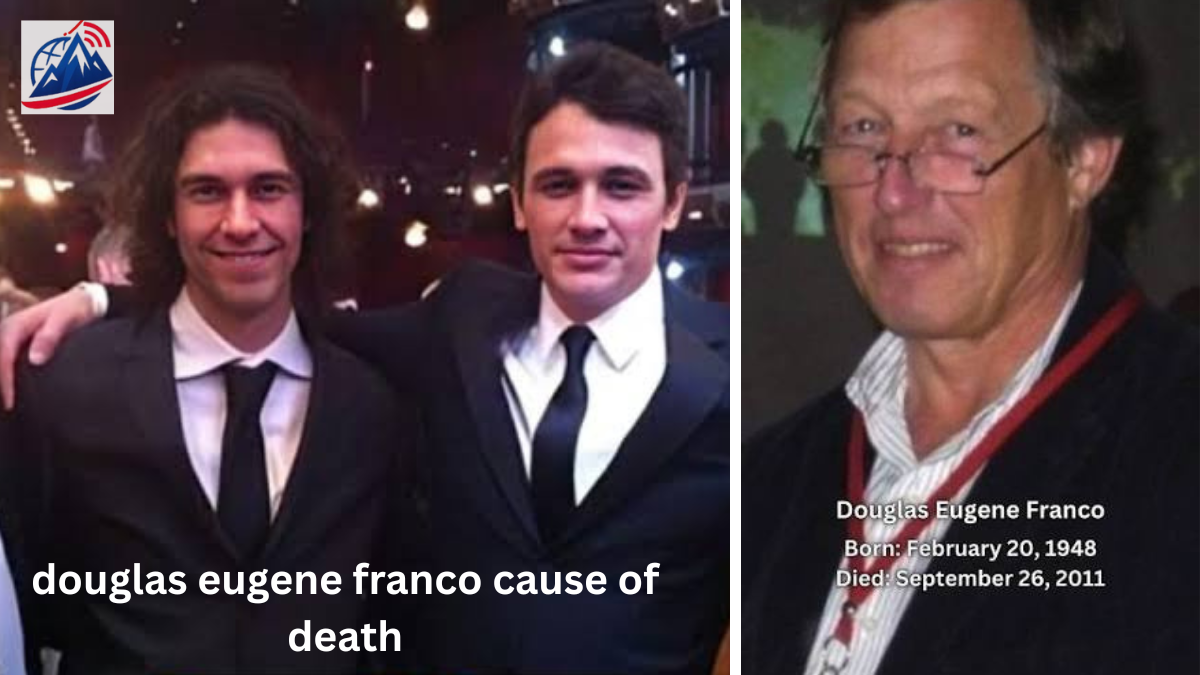
When people search for “Douglas Eugene Franco cause of death,” they are usually looking for information about the father of actor James Franco. Douglas Eugene Franco lived a relatively private life compared with his famous son, but his own story was interesting in its own right. He was a businessman, entrepreneur, philanthropist, husband, and father who built a career in Silicon Valley while also making time for art, meditation, and humanitarian work.
Douglas died on September 26, 2011, in Palo Alto, California, at the age of 63. The most commonly repeated explanation online is that he died from a heart attack. However, the available public record is not completely consistent. His published obituary confirms his death but does not state a medical cause, while some later biographical sources describe a heart attack and another genealogy-based source lists liver failure. For that reason, the most responsible conclusion is that a heart attack is widely reported but not firmly established by a publicly available primary medical record.
That distinction matters because searches about celebrity relatives can quickly turn into a mixture of repeated claims, assumptions, and copied information. Looking at Douglas Franco’s life more carefully gives a much more complete picture. His story was not simply about how he died; it was also about what he accomplished, the family he raised, and the humanitarian values he carried throughout his life.
Who Was Douglas Eugene Franco?
Douglas Eugene Franco was born on February 20, 1948, in Glencoe, Illinois. He later became associated with Palo Alto, California, where he built his professional and family life. Genealogical records identify his parents as Daniel Franco Jr. and Marjorie Jane Peterson, and records place his death in Palo Alto on September 26, 2011. He was 63 years old.
Douglas became particularly well known because he was the father of actor and filmmaker James Franco. He and his wife, Betsy Franco, also had two other sons, Tom Franco and Dave Franco. While his children eventually became involved in the arts and entertainment, Douglas followed a very different professional path. His background was rooted in mathematics, business, technology, and entrepreneurship.
One of the most interesting aspects of Douglas’s personality was the combination of analytical thinking and artistic curiosity. His obituary describes him as someone with a generous spirit and a strong interest in meditation. It also notes that he returned to life drawing sessions during the final year of his life. That detail provides an unusually personal glimpse into a man who could move comfortably between business, family, philanthropy, and creative pursuits.
Douglas Eugene Franco’s Education and Early Career
Douglas’s educational background helped shape his professional direction. Sources about his life describe him as having studied mathematics at Stanford University before earning an MBA from Harvard. His education gave him a combination that was especially useful in the developing technology environment of Silicon Valley: strong analytical skills paired with formal business training.
His connection to Stanford was important on a personal level as well. According to his obituary, Douglas met Betsy in a life drawing class at Stanford. That is an interesting detail because it shows that art was not simply something that appeared in his later years. It was part of his life long before he became a businessman and long before his sons became known in Hollywood.
Douglas eventually established himself within the Silicon Valley business community. He worked in the technology sector and was associated with companies including Xerox and ROLM/IBM, among others. Rather than being a celebrity entrepreneur, he was primarily a business professional whose work took place behind the scenes. His career coincided with a period when Silicon Valley was rapidly changing the American economy, making his professional experience particularly significant.
His Career as a Silicon Valley Entrepreneur
Douglas Eugene Franco’s professional story went beyond simply holding corporate positions. He also founded businesses of his own. One of the ventures associated with him was SecureBox Corporation, which focused on security technology for shipping containers and ports. The idea reflected a practical approach to entrepreneurship: identify a real-world problem and develop a solution that could potentially improve safety and security.
SecureBox was an example of how Douglas combined his technical and business interests. Port and shipping security may sound far removed from the entertainment world associated with his son James, but it helps explain why Douglas’s own career deserves to be discussed independently. His professional identity was connected to technology, problem-solving, and entrepreneurship rather than Hollywood.
His career also appears to have given his family a stable environment in which creativity could flourish. James Franco eventually pursued acting, while Dave Franco developed his own career as an actor and filmmaker, and Tom Franco became involved in art. The family’s different professional directions suggest that Douglas and Betsy created a household where their children were able to explore individual interests rather than being forced into a single career path.
Douglas Franco and His Humanitarian Work
One of the strongest parts of Douglas Franco’s legacy was his humanitarian work. His obituary states that his generous spirit and meditation practice led him to found Orchard International, an organization dedicated to sending humanitarian aid to developing countries. That effort added another dimension to his life, showing that his interests extended well beyond business success.
Orchard International focused on providing practical assistance to people facing difficult circumstances. Later accounts of Douglas’s work describe aid involving medical supplies, clothing, food, and other necessities. Some sources have reported that the organization distributed millions of dollars’ worth of humanitarian supplies internationally, including assistance reaching communities in countries such as Afghanistan, Iraq, Ethiopia, India, and the Philippines.
This humanitarian side of Douglas’s life is important because it changes how his biography is understood. He was not simply a Silicon Valley businessman who happened to become the father of famous actors. His professional abilities were connected to a broader philosophy of service. The combination of entrepreneurship and philanthropy suggests that he viewed success as something that could be used to help other people rather than simply as a measure of personal wealth or status.
Douglas Eugene Franco’s Family Life and Influence on His Sons
Douglas was married to Betsy Franco, a writer and artist whose creative career complemented his own interests. Their relationship began through their shared interest in art, with the couple meeting in a life drawing class at Stanford. Together they raised three sons: James, Tom, and Dave Franco.
James Franco became the most internationally recognizable member of the family through his work as an actor, director, writer, and artist. Dave Franco later established his own acting and filmmaking career, while Tom Franco pursued the visual arts. Although their professional lives developed in different directions, all three sons grew up in an environment where creativity was clearly valued.
Douglas’s influence was not necessarily about directing his children toward particular professions. Instead, the available accounts portray him as a supportive father who valued curiosity, discipline, creativity, and intellectual development. His own combination of mathematics, technology, entrepreneurship, art, and humanitarianism provided an unusual example for his children. That kind of influence can be powerful precisely because it does not require a parent to dictate a specific career.
Douglas Eugene Franco Cause of Death: What Really Happened?
The central question remains: what was Douglas Eugene Franco’s cause of death? Douglas died on September 26, 2011, in Palo Alto, California, at the age of 63. This date and location are supported by multiple biographical and genealogical records.
The difficulty comes when looking for the exact medical cause. Several biographies published online state that Douglas died from a heart attack. One recent account specifically describes a heart attack in Palo Alto, while another says that a heart attack has been widely reported but that full clinical details were never made public.
At the same time, there is a reason to be cautious about stating the heart-attack claim as an absolute fact. Douglas’s 2011 obituary published by the San Jose Mercury News and San Mateo County Times confirms his death and describes his family, career, humanitarian work, and interests, but it does not give a medical cause of death. In addition, an AncientFaces profile currently lists “liver failure” as the cause, creating a direct conflict with the widely repeated heart-attack claim.
Therefore, the most accurate way to answer the search query is this: Douglas Eugene Franco died on September 26, 2011, at age 63, and a heart attack is the commonly reported cause, but the publicly accessible sources do not provide enough primary evidence to treat that detail as definitively confirmed. The liver-failure claim should also not be presented as established fact simply because it appears in a genealogy database.
His Final Years and the Meaning Behind His Legacy
One particularly touching detail from Douglas’s obituary is that he returned to life drawing during the final year of his life. This connected the end of his life with one of the activities that had been part of his earlier relationship with Betsy. It is a small detail, but it gives his biography a more human quality than a list of corporate achievements ever could.
Douglas’s legacy therefore exists in several different areas. There was his professional contribution to Silicon Valley, his entrepreneurial work through ventures such as SecureBox, his humanitarian efforts through Orchard International, and his role as a husband and father. None of these elements alone explains the whole person. Together, however, they create a much more complete portrait.
His death was understandably significant for his family. James Franco was already a major public figure by 2011, and the loss of his father occurred during an important period in James’s career. But Douglas’s legacy does not depend entirely on the fame of his sons. His own work in business and philanthropy provides enough substance to make his life noteworthy independently.
Where Was Douglas Eugene Franco Buried?
Following his death in Palo Alto on September 26, 2011, Douglas Franco was buried at Alta Mesa Memorial Park in Palo Alto. Genealogical records give the burial date as September 30, 2011.
The obituary published on September 30, 2011, also provides insight into how those close to him remembered him. Instead of focusing primarily on his connection to James Franco, the notice highlighted Douglas’s generosity, meditation practice, entrepreneurial activities, humanitarian work, and artistic interests.
That is worth emphasizing because public curiosity about Douglas often begins with his famous son. Yet the contemporary obituary paints a broader picture. Douglas was remembered as a supportive father and an individual with his own accomplishments and passions. In that sense, his legacy is much larger than the answer to a question about how he died.
Frequently Asked Questions About Douglas Eugene Franco
What was Douglas Eugene Franco’s cause of death?
The most widely reported cause is a heart attack, and several biographical sources repeat that explanation. However, Douglas’s 2011 obituary does not publicly specify a medical cause, and another genealogy-based source lists liver failure. Because of this conflicting evidence, it is more accurate to describe a heart attack as the commonly reported cause rather than an independently confirmed medical fact.
When did Douglas Eugene Franco die?
Douglas Eugene Franco died on September 26, 2011, in Palo Alto, California. He was 63 years old. Records also indicate that he was buried at Alta Mesa Memorial Park in Palo Alto several days later.
Who was Douglas Eugene Franco’s wife?
Douglas was married to Betsy Franco, a writer and artist. The couple reportedly met through a life drawing class at Stanford, making art an important part of their early connection. They raised three sons together: James, Tom, and Dave Franco.
How many children did Douglas Eugene Franco have?
Douglas and Betsy Franco had three sons: James Franco, Tom Franco, and Dave Franco. All three developed interests in creative fields, although their careers took different directions. James became an internationally known actor and filmmaker, Dave pursued acting and filmmaking, and Tom became associated with visual art.
What did Douglas Eugene Franco do for a living?
Douglas was a Silicon Valley businessman and entrepreneur. He worked in the technology sector and was associated with companies including Xerox and ROLM/IBM. He also founded SecureBox Corporation and became involved in humanitarian work through Orchard International.
What was Douglas Franco’s legacy?
Douglas Franco left a legacy that combined business, philanthropy, creativity, and family. His professional life connected him to Silicon Valley entrepreneurship, while his humanitarian work reflected a commitment to helping people in difficult circumstances. He was also remembered as a supportive husband and father.
Final Thoughts on Douglas Eugene Franco
The search for “Douglas Eugene Franco cause of death” begins with a straightforward question, but the answer is more nuanced than many online summaries suggest. Douglas died in Palo Alto on September 26, 2011, at the age of 63. A heart attack is frequently cited as the cause, yet the available public sources do not provide a definitive primary medical record confirming that explanation. His obituary does not state a cause, and at least one genealogy source gives a different cause, so responsible reporting requires that uncertainty to be acknowledged.
What is much clearer is the story of the man himself. Douglas Eugene Franco was a Silicon Valley businessman, entrepreneur, philanthropist, husband, and father. He helped build businesses, established a humanitarian organization, practiced meditation, maintained an interest in art, and raised three sons who eventually developed their own creative careers.
Perhaps the most meaningful way to remember Douglas is not through the circumstances of his death but through the range of his life. He successfully combined analytical thinking with creativity, business with service, and professional ambition with family values. Although his name is often searched because he was James Franco’s father, Douglas Eugene Franco had a story of his own — and that story remains worth remembering.
You May Also Read:Roderick Jeffrey Watts: 7 Powerful Facts About His Life, Career, and Lasting Legacy
for more visit newspeaka.co.uk
